Showing posts with label intellectual property (IP). Show all posts

Friday, February 21, 2025

Keep Your Drink Warm with some IP

You know what I really appreciate? Travel coffee/tea/whatever mugs that keep my beverage hot for hours. And not just a couple, but for 5 or so. Up until recently, I'd been using the same one for well over a decade because it was so incredibly effective. Unfortunately, it finally broke, and I was forced to use a newer version of the same container--only to find that it's not nearly as good! What happened?

I know for a fact that my old travel mug had multiple patents (this is me, of course I looked). Why abandon them? Ok, aside from the fact that given the age of my tumbler, they had likely passed into public domain (remember, patents have specific time limits). But that doesn't mean they couldn't continue to use the same design.

In celebration of the life of the coffee mug I loved and lost, and in hopes that the new one I bought for my husband's birthday is better--despite being the same brand--let us look at some Contigo (owned by Ignite USA) coffee tumbler lid patents. 

Please pay no mind to the table chaos in the background
There are three listed on the base of my current tumbler: 7,546,933, 7,997,442, and D564,841. Without looking them up, I can tell you immediately that these are not at all new and have quite likely passed into public domain. Since it also claims patent pending, I must assume newer tech is also at work. Let's look for the newer ones. Also, both of the utility patents are continuations within the same family and don't appear to be the tech behind the particular mug they're printed on, which makes them even less interesting for this entry. 

Also, I'm going to stick to utility patents, because that would be more relevant to the ability to keep my coffee warm for long periods. 

Contigo/Ignite USA haven't been very active lately when it comes to patents, as it turns out. There is nothing more recent than 2020--either granted or in application phase. This is a little disappointing, but perhaps their business plan has its reasons.

Let's look at US 10,336,513 Lid Having a Pre-venting Lid Lever and a Seal Arm Assembly. It looks moderately similar to what I have, but not quite the same. I think it's a different model; perhaps it is more effective. Maybe I should buy more tumblers and find out!

A diagram of the lid assembly from US 10,336,513
Next up is US 10,455,959 Portable Beverage Container with a Robust and Easily Cleanable Seal Mechanism. It's nothing like the coffee tumblers I know--it looks more like it is intended for chilled beverages, with the straw-like opening.
A diagram of the patented lid for US 10,455,959
This image makes the lid look impossibly complicated

Finally, we have US 10,898,017 No-Spill Drinking Container, that again looks more like it is for a chilled beverage, similar to the above. In fact, they might be for the same whole bottle, just different parts.

An image of the diagram for US 10,898,017
It is hard to spill when drinking with a straw
 

How disappointing! None of these are for my coffee mug and none of them explain why the newer version is less effective. Perhaps more research of other patents and other patent office databases would be required.

Friday, April 26, 2024

Flowbee: As Seen on TV (in 1989)

In a recent conversation with my husband, I mentioned that I needed to give some of my plants a "haircut", but I wasn't sure how to accomplish it. He facetiously recommended I use a Flowbee, and I responded with something along the lines of "Duh whuh?"

He proceeded to try to explain the concept of some kind of vacuum cleaner hair cutter device to me, without the aid of visuals, in a rare moment we were both without our phones. Very little was clarified except that it was fairly well known in the 1980s, mostly through TV advertisements. 

Later, once we were again fully plugged in and had phones available, he showed me a few YouTube videos--including this one I can't embed--that made sense of things, including some 80s and 90s hairstyles. Equipped with a better understanding of a Flowbee, I finally got the joke. But my mind was, of course, drawn to speculating on its IP.

The vacuum hair hero; image taken from flowbee.com
Despite my husband's immediate assurances, I wondered if it was patented.

Turns out, the guy behind the Flowbee™ has his IP locked down.

I'm telling you, not even Rice is this careful about international coverage. 

Yes, it also has trademarks, and this is the official specimen on record
Rick Hunts, the inventor of the Flowbee™, obtained his initial patent for "Hair Clipper" in 14 different jurisdictions, likely through this WIPO patent application. The patent was granted in at least 7 of those, including Germany (twice, potentially reflecting the geopolitical status in the 1980s), Australia, Canada, and the European Union. The US Patent for the Hair Clipper, US 4,679,322, was granted in July of 1987... shortly before I was born. 

There are a few other Flowbee™-related patents that were filed and granted later. These, I presume, are for improvements or new accoutrements, judging by the names "Grooming Attachment for Vacuum-Drawn Clippers", "Vacuum-Drawn Hair Clipper", and "Vacuum-Powered Hair Cutting Guide". All were filed within a few years after the initial hair clipper, but seemingly only in the US. Who knew a vacuum-enabled hair clipper could have so many improvements?

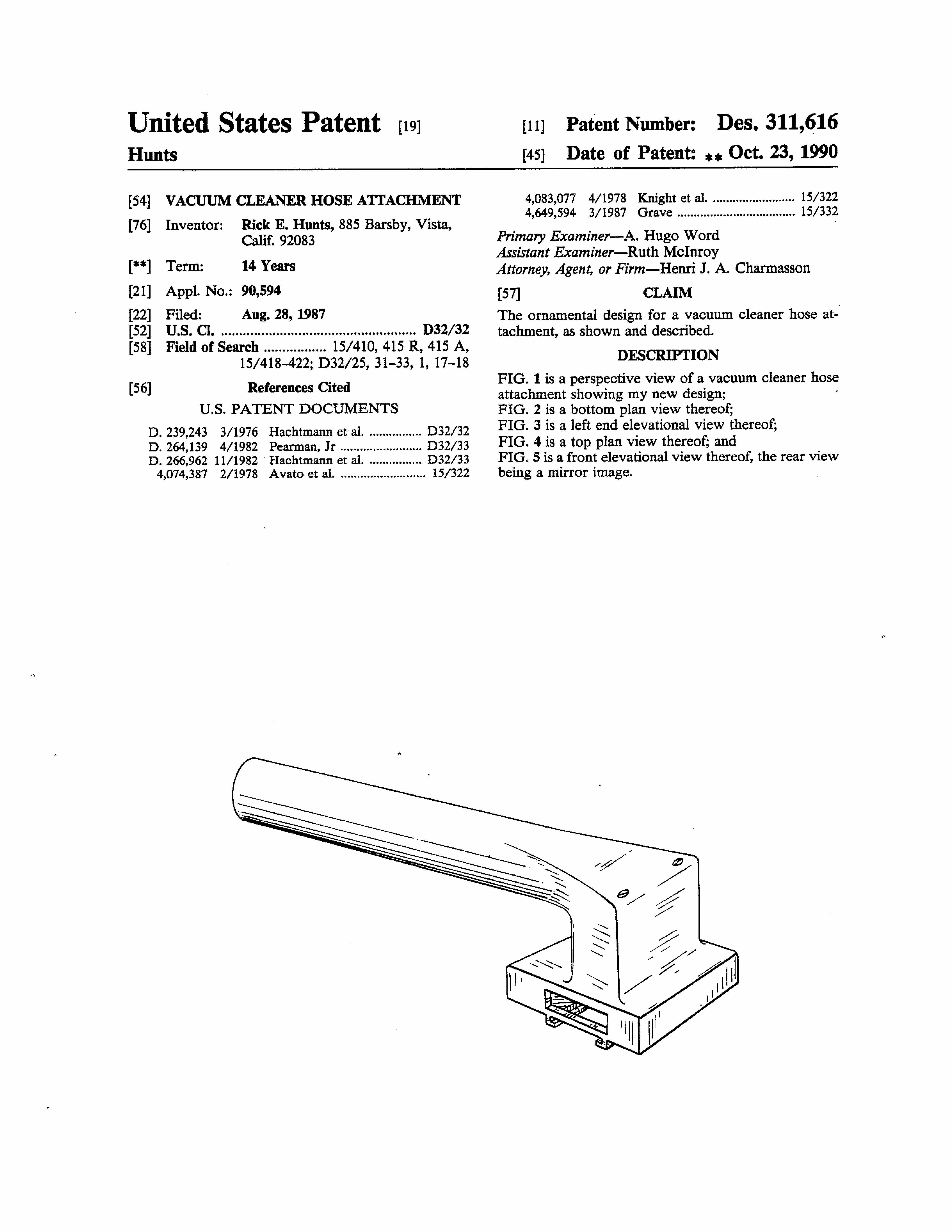
Hunts also owns a design patent in the US for the "Vacuum Cleaner Hose Attachment", D311,616. 

Apparently a distinct ornamental design
Today, all of the Flowbee™ patents have expired, so it's possible there are many versions available. 

And, as it turns out, I could have used one adapted for plants, because my pruning was a mess.

Monday, March 18, 2024

Triple Dog IP Dare

You know, I spend a lot of time thinking about IP, even outside working hours. It's a side effect of not only my position, but this blog. Because I've made a point to investigate aspects of IP that are more likely to apply to an average person's life, or perhaps spark some interest in a person who isn't concerned with the technical side of things, I now find that I can't stop myself from considering IP. After all, who knows when I might be able to pick up a topic that will make for a good blog post, or perhaps lead to some exciting search possibilities?

Unfortunately, that means a lot of people around me have to think about IP more than they might like, too. 

It's a hazard of the occupation, and I'm sure it's not unique to this one, either. 

Recently, it was during one of the involuntary, impromptu, work-unrelated IP moments that I had a small, yet terrifying epiphany.

IP is everywhere and concerns everything in our lives. It can be applied to everything. You cannot escape the presence of IP!

Try me, I dare you. You name it in a comment, and I'll show you some relevant IP. In fact, I triple dog dare you. There's no going back from that.

Tuesday, February 27, 2024

A Squishy IP Reprise

Well, I somehow ended up with two Squishes in my office. One is a Squishmallow, and the other is a Squishable.

I cleared some space on a chair for them
Also, when I said "somehow", I should clarify that I intentionally purchased the pickle Squishmallow for my office, because clearly no office is complete without a pickle plush.

I think the best part is that the Squishable is actually the ~Mysterious Doctor Plague~ who had a featured trademark appearance in my previous entry. I received him as a gift for Valentine's Day, my husband completely unaware that my blog had focused on that particular bit of IP. (If you're wondering why I got a plague doctor Squishable for Valentine's Day, it's because St. Valentine is the patron saint of plagues, along with beekeeping and epilepsy. So he gave me a plague doctor, a bag of Bit o' Honey, and conceded that he couldn't figure anything out for epilepsy.) 

Squishily mysterious!
I was not incorrect about some of my suppositions when it came to differentiating the two. The Squishmallow is not as articulated, and has a more velvety texture than a fake fur, like the Doctor Plague. Otherwise, the best indicator might just be knowing your brands and checking those marks!

Anyway, enjoy these close-up views of trademarks and their registration symbols, all from residents of my office.


Friday, February 16, 2024

If the Shoe Fits, IP It

Shoes are amazing. I mean, I really like shoes. I am a shoe person. If you work in Fondren, chances are you've noticed some of my (very impractical) shoes.

Just in case you were wondering about today's pair

In light of that, I cannot believe I've hardly spent any time on shoe IP! 

But, I attended a talk at the Rice Business school with Stuart Weitzman recently (I didn't win the raffle for custom boots and am still feeling pain), and it really inspired me to think about shoe IP. I even asked Mr. Weitzman about his IP, wondering if it was challenging to register his personal name for a trademark. He said it was no problem--which I didn't expect, but then, there probably weren't a lot of Stuart Weitzmans trying to register their names for fancy shoes. 

The thing is, I recall just staring into the window the the Stuart Weitzman store in the Galleria, ogling those shoes, when I was younger. It was the kind of store I didn't even have an excuse to go into, so I just stood outside and lusted after the display shoes, which were beyond impractical for a 13 year old. At the time, I was just coming into my unique shoe tendencies, which were inspired in no small part by the fact that I attended a uniformed school, where we had to wear tennis shoes most days and "dress" shoes on dress days. The "dress" shoes were (for some unfathomable reason) Doc Martens, and every single girl in my grade always managed to have the exact same style of New Balances. But then I discovered that some athletic shoes also came with metallic striped colors. And Vans released a style that turned (in my case) pink in the sun. Once I found out I didn't have to wear plain athletic shoes to meet the standards of a uniform, my life's work of finding unique shoes began. Athletic shoes in pink suede with faux fur? Check. Throwback Roos complete with zippered pocket and neon colors? Check. Buckled mules with wooden soles? Check. My grandmother's vintage Uggs (about four sizes too large), before they got popular years later? Check. Bright orange patent leather flat platforms? Check. High heels on sparkly flip flops? CHECK!

As an adult, the world of shoes only grew wider. And in celebration of how much fun shoes are, and how they can come in any imaginable variety today thanks to designers like Stuart Weitzman, let's explore some IP.

We really must start with Mr. Weitzman's trademark, since it inspired this whole entry. Now, there are many registered marks under that name, for a variety of goods and services. But what we want most are shoe-related marks. A number are the word mark Stuart Weitzman, for "retail store services featuring shoes" and etc. Like, 3 live ones: 2749908, 5110490, and 4971730. The trademark registration number for just shoes as a good is 1386002, dating back to 1985. 

Two others stand out to me a little more. The first (registration no. 2571208) is for the word mark phrase "A LITTLE OBSESSED WITH SHOES", which is from an early advertising campaign that was brought up during his talk. It worked brilliantly, because it was a clever strategy to spread brand familiarity and even loyalty, rather than just a shoe. Unfortunately, I can't find an image from the earliest of these, but I have shared below the images used as specimens in the TSDR.

I understand this one not at all

But note the bottom left: a little obsessed with shoes
Secondly, there's the registration for the architectural design of his stores. Apparently, this unique look by the famous Zaha Hadid helped him achieve new markets. It's also a good reminder that IP goes beyond logos and brand names, and into the overall branding strategy. 3797782 is for trade dress, a niche sort of service mark. 
A registered retail store appearance
I hope Mr. Weitzman forgives me for my poorly worded question, and for drooling on his store's windows decades ago. 

Luxury shoes aren't just for women or high fashion. Probably the most iconic, recognizable shoe today is an Air Jordan. It is equally acceptable for a man to collect and covet shoes when it comes to this brand, whereas one might otherwise (at least in certain age and social groups) face some scrutiny or censure. 

The currently active word mark "Air Jordan" was first registered in 1985, no. 1370283. It does not claim any color, style, etc., just the characters, and is for footwear and athletic clothing. Michael Jordan might have been long remembered for his basketball career, but this brand (actually owned by Nike) has made him truly immortal. 

Who doesn't know this?
My first thoughts when I think of the brand are of the jumping silhouette imposed on the words Air Jordan, but surprisingly that is not a registered mark and never was. Issued serial no. 74041037 in 1990, this combo word and design trademark was marked abandoned and finally invalidated in Nov. 1994.
I don't know this
I clearly don't keep up with this brand, since they've been using registration no. 3725535 trademark design since 2009. It's incomprehensible to me, unless they're trying to move away from Michael Jordan as a person. Those jumps were famous. Perhaps with time, they assume that reputation has faded, or that the Nike swoosh (too many registrations to list) is branding enough. Or perhaps they just want to use it without having to manage it as a trademark, since it still shows up in a substantial number of their specimen photos.
Why yes, they did select something out of date for a specimen
In my defense, their specimen for the word mark has the silhouette, and so does the small icon on the Wikipedia brief. So there.
Why would they abandon this? To move away from the Jordan person?
Want another shocking piece of shoe trademark info? Louboutin (a brand of shoe as swoon-worthy as Stuart Weitzman's) does not own that specific color of red as applied to the sole of a shoe. At least, not in the U.S. You can see on the TSDR record that it is registered in France. 

I'd like to move away from trademarks, though, and look at a few design patents. Mr. Weitzman mentioned design patents when I asked my (poorly phrased) question. He seemed dismissive, but I notice a few brands rely quite heavily on them.

First, Nike was probably the frequent assignee I found in my search. Here's an example of one that might relate to Air Jordans, US D1,004,270.

Could be Air Jordans, or it could just be citing them
Another designer name I notices, if not as often as Nike, was J. Choo. Jimmy Choo makes some very nice shoes; that's a brand up there with Weitzman and the likes of Louboutin. Even Terry Pratchett knows they're good shoes (if ever an author wrote some great librarians, it was Sir Pratchett--and I don't just mean The Librarian). This is a fancy shoe. To see the color version of the photo, visit this link.
Almost has a early 1900s feel
And finally, because not everything in life is about fancy shoes, here's a patented Crocs design. I've never owned a pair of Crocs, but I'm aware of their popularity, and that everyone wants to copy them. This version won't be duped! Thanks, US patent D1,001,431.
Don't copy these
With that, I need to stop looking at shoes. I already went shoe shopping and bought another pair thanks to these recent events. Just remember: if you like the shoe, it doesn't matter if it's fancy or expensive. What matters is if you can wear it and you like it! Fit isn't event that important if they're as good as the pair below, which are so cheap they don't even have a brand.
Too cheap for functional buckles, but still great


Thursday, December 21, 2023

Holiday Special Post! Magnetic Tape and IP Are Disappointing Star Wars Fans

Let's talk about copyright, and in particular, Star Wars.

For those who may not know, Star Wars is among the most valuable franchises, and has more IP than I'd care to try to list. And while the franchise spans games, toys, books, TV shows, clothing, amusement parks, and probably food items, it all stemmed from a project in the 1970s that came with no small amount of scorn and doubt. 

Today, we all know and love the original Star Wars movie (later A New Hope), copyright 1977. However, many have only seen specific edited versions, or "special editions", that came later. In fact, there aren't a lot of viewable copies of a widescreen (normal. Today that's just normal.) original version. That is something of a collector's item--and not just according to the label.

Yes, dear readers, I have a copy of the original trilogy on VHS in widescreen. 

An image of a boxed set of the original Star Wars movie trilogy on VHS tapes, widescreen version
Widescreen was once an optional format
And, like many people, I would like to own that version on a slightly more contemporary media format. Why I can't purchase it on DVD or stream it is another story. Briefly, after editing his films Lucas didn't want the older version distributed, meaning that I might be able to find a bootlegged version or a non-professionally edited copy, but not the true originals. 

So, with help from the staff in the Digital Media Commons (shout out to Ian), I decided that this slow time of year was perfect to transfer it to DVD. [Look, I know that it's copyrighted material and I am pretty familiar with the basics of copyright; but I didn't intend sell, distribute, show in public, etc. the DVD. I just wanted to be able to watch my movies at home.]

An image of a message on a screen that says copying is not allowed, shown over the Star Wars typeface font
Bad news, fans

As it turns out, someone foresaw this type of activity, and there's a built-in mechanism that prevented me from making a DVD copy. Apparently, a part of the magnetic tape has been encoded. This is distressing because VHS has a fairly short shelf-life, and there aren't many players left that don't destroy or damage a tape due to age. Furthermore, finding a VHS player that is compatible with modern TVs or screens is challenging, and becoming impossible. Even the converters are harder to find, and tend to be more unreliable.

An image of a boxed set of the original Star Wars movie trilogy on VHS tapes, showing the three tapes boxes
A boxed set of sci-fi, space drama joy, a Collector's Edition!
What is most frustrating about this, in my opinion, is how many times people likely recorded the movies from onto VHS, or Tivos, or whatever, back in the day. This fairly common practice clearly never affected the value of the original property. I mean, it's worth billions! People attempting to make a copy of this specific VHS could not have been widespread enough to affect the overall value of the Star Wars franchise, either. 

Here's some potential evidence for my reasoning that people who recorded Star Wars material haven't destroyed the value of the original.

In 1978, there was a televised event, the Star Wars Holiday Special. It was made to capitalize on the success of Star Wars, and also the holiday season. It was aired a single time, because it was simply just so awful. In fact, the people behind it did their best to try to forget it ever happened and hope that the rest of the world would, too.

Well, people don't always forget things, and fortuitously (?), some viewer decided to record the Holiday Special. As one might expect, the advent of the internet and the web led to it turning up online, and the Holiday Special had quite the renaissance decades later. It feels like only one copy of it was ever retained, because most of us have seen an ad for a local news report after the special. Who knows, maybe someone has the original shots and tapes somewhere. But given Lucas' opinion and attitude towards the Holiday Special (which is allegedly that he was mostly uninvolved and wasn't it awful what those TV people did?), it is no surprise that he didn't have his company distribute copies.

Despite the train wreck that is the Holiday Special and its refusal to die, Star Wars didn't lose any of its value. Not even immediately following the international airing of it, and almost universal bad reviews. The later bootleg versions that so many of us fans have seen haven't tarnished the value, either. 

So why stymie fans like myself, who just want a semi-modern copy of movies they love? We aren't a large enough force to impact the value of Star Wars, and never have been. By the time this collectors' edition was released, all three films had been out for years, and available on multiple media formats.

An image of a boxed set of the original Star Wars movie trilogy on VHS tapes, showing the three tapes boxes and the VHS for the first movie
A VHS I failed to copy today
I'm going to assume that perhaps most commercially made VHS of a similar quality has these built-in safeguards, and that it isn't just Lucasfilm or 20th Century Fox being particularly cruel about their IP. Perhaps it was standard manufacturing process to include.

I'm still mad, though. I was planning on watching the movies during the break.

Wednesday, November 29, 2023

First Sale Doctrine and You

Like me, I know you've definitely contemplated how it is permissible for books and other products to be resold without violating creators' or original owners' intellectual property rights.Why is it okay to sell a book to Half Price Bookstore, who resells it, when the contents of that book belong to a copyright holder? How is it legal for vintage stores to sell branded garments from internationally recognized trademark holders like Nike, complete with the trademarked Swoosh? If car dealerships are independently owned and operated, why are they permitted to sell vehicles that are comprised of many patented parts, bearing trademarked logos and even appearances?

After all, in many of these case, the products have been altered or associated with a new brand. New cars come with post-manufacturer upgrades that don't void warranty or make them any less a version of their original make and model. Some vintage stores have embellished garments or accessories that are still sold using the original product's familiar qualities, using that to add market value. 

Patent law says that assignees have the right to exclude others from making, using, selling, offering for sale in the U.S., or importing into the U.S., their patented inventions. Copyright law grants owners the right to selling copies, performing, exhibiting, displaying, playing recordings of, and distributing reproductions of their work, and authorizing others to do any of those. Trademarks grant businesses the right to use a specific image, phrase, sound, or some other media to identify their brand and product.

These aren't cases of licensing, in which creators or owners allow a third party to use their IP for a fee or some other exchange. 

So why aren't dealerships sent cease and desist notices, clothing resellers taken to court for trademark infringement, and authors/publishers suing second hand book stores for royalties?

What we're looking at here are all cases of first sale doctrine--a legal precedent near and dear to all librarians' hearts (which may also be described as exhaustion when concerning patents). It's an interesting aspect of IP law that can be applied in roughly the same way to patent, trademark, and copyright cases. 

Generally speaking, the specific rights to income from IP for an item stop after the first sale to the general consumer market. 

An important part of this to keep in mind: it is the specific copy or item that first sale doctrine applies to, not the concept or work--the true IP at stake.

In the case of copyright, I can resell a book but not make copies of it, or perform public readings from it, or create a movie based on it. Only that one copy, that particular item, is subject to first sale. 

Similarly, the same applies to products with trademarks appearing on them. Reselling the branded product does not infringe, only reusing the actual trademark separately would. In our example above, applying the Nike Swoosh to the name of a resale store, or using it to represent the store in some way, would be the violation. But carrying products that have the mark is distinct. 

Think of it the same way in terms of patents: a vehicle with patented components is a single instance of that patented technology. The actual patent, or producing more vehicles with the same patented components, is not for sale or distribution.

It is also important to note that first sale doctrine, primarily when applied to trademarks, also stipulates that the re-selling does not negatively impact its value. If the general consumer's goodwill towards a brand is damaged because of the resale, then first sale doctrine may not apply. 

The seller also needs to make it clear, in many cases confirmed by courts, that they are not the actual owner or representatives of any items. That's kind of why "independently owned and operated" gets thrown around a lot (though only one reason). 

To combine those two concepts, if I turn Nike athletic shoes into a pair of sandals, they can't be such poor quality that it reflects negatively on the overall Nike brand. I also can't represent my sandals as something licensed or produced by Nike. It must be very clear that these are Hannah's athletic sandals, sold by Octopeds™ company. [Octopeds™: they're so great, you wanna wear eight!]

Of course, we have to consider that any one of these examples may not go the way I propose them in a court of law. A company like Nike may not look too kindly on someone messing with their products; if they take me to court, they're going to win just because I can't afford to compete with their legal resources.

Also, I'm not a lawyer or a legal expert, so don't quote me or my blog on this. Use the linked pages, they are more authoritative.


Are you confused yet?

Yeah, me too. Let's go look at internet cats or something instead.

Monday, August 14, 2023

Common IP Misconceptions

There are a few major misconceptions and fallacies regarding various types of intellectual property I encounter somewhat regularly. In this post, I'll address the most common and explain why they're problematic. Hopefully, this post will help others avoid similar pitfalls.

If I've missed anything, let me know in a comment!

Patents can be issued not only for new inventions, but also for improvements to those that already exist. However, improvements must still meet the three most basic requirements for patentability: new, useful, and non-obvious (for more, see the LibGuide Patent Basics tab on Patentability). That leads to the first myth/misconception: 

Make Two (2) Changes 

"If you make two (2) changes to something that exists, then it's a patentable improvement." Don't fall prey to this thought. In fact, never think it again, because it is misleading in many ways. The three most basic requirements above are what you need to use. Two changes to an extant invention could be two very obvious changes; for example, if I make something purple and twice as large, that's hardly novel. Furthermore, a single change can be sufficient improvement to qualify for patentability. What counts as non-obvious or new can be little murky, and it's impossible to specifically define and still apply to all inventions. Using any kind of concrete quantification like the above will only cause problems.

The process of applying and filing for IP protection can be both arduous and expensive. While assistance is available via multiple sources (not explored here), it sometimes does not seem worth it to purse official government registration. People go to extraordinary lengths to try to beat the system, while avoiding high costs and lengthy procedures. Many people might attempt this: 

Mail it to Yourself (Patents)

I've met more than one person who has referred to this "Poor Man's Patent". Take proof of the invention and your signature, seal it in a envelope addressed to yourself, date stamp those sealed edges and mail it so you have official government proof of the date. It's a cool idea... If patents were possible to obtain without any sort of widespread, official public disclosure, or, y'know, granted to the first to invent rather than first to file. Since the Leahy-Smith America Invents Act of 2011, the USPTO gives precedence to inventors who file for an invention first, not show proof they were the first with the idea. So unless you really need some kind of semi-official evidence that you had an idea before a date (and I don't know of any related to obtaining patents), this is a waste of time, energy, and postage. 

Mail it to Yourself (Copyright)

Do the same thing as above, except instead of proof of invention or idea, enclose a recording or hard copy of your creative work. In fact, this is (somehow) even less useful. I learned local musicians used this method to try and secure copyrights on the cheap. In the US, copyright is automatically applied to any creative work as soon as it is "fixed", or recorded in some physical or digital format. This blog? Covered by copyright laws. Photos on your phone? Subject to copyright. Poem you wrote on a grade school assignment? Technically copyrighted. Unfortunately, any sort of realistic legal protection or enforcement of those copyrights is almost impossible if the work isn't registered with the US Copyright Office. Also unfortunately, the musicians didn't know they had a cut-rate copyright before wasting time, postage, recording media, and shipping material, and the effort earned them no extra protection.

Unlike patents and copyrights, a mark registered with the USPTO can be infinitely renewed, remaining a protected registered mark, so long as it is in use. Also unlike copyrights and patents, any mark that is considered "dead"--abandoned, cancelled, filed but not registered--does not become public domain. Confusion about what it means when a mark is dead leads some people to the next erroneous conclusion:

A Dead Mark is Free to Use

As in the first example, reality is much more complicated. It is possible a commercial entity could choose to let a mark "die" yet still continue to use it to represent their good or service. Perhaps the cost of maintenance was too great a burden, who knows. If the owner makes a point to remove the registered symbol, they can keep using a mark with common law protection provided by the TM or SM symbol. For another entity to start using that mark woudld be infringement. And that's just one potential scenario. Trying to register a mark that already exists might cause rejection on the basis of likelihood of confusion, or objections from prior owners, among others. To use an extant mark, the rights to it must be purchased from the owner or through re-registration via the USPTO. The only time a mark might be considered to have entered public domain is if it has suffered from "genericide".

Not everyone has a fully-formed plan when they choose to pursue a patent. Sometimes, inventors or investors view obtaining a patent as the end goal.  However, a patent should be one part of a larger business plan, or an inventor/owner may find they've wasted time, money, and effort. One of the fallacies that leads to people simply wanting a patent without knowing why:

Patents Earn Money

A patent can lead to an income, but just having one does not guarantee any. In fact, some (many) patents will never generate a cent. Inventors and owners can make money by marketing the invention, licensing the technology, or selling the rights to the patent. Even then, there is no assurance that a significant amount will result. Patents are an exclusionary property right, and nothing more. They grant owners the right "to exclude others from making, using, offering for sale, or selling" the invention in the US or importing it into the US (according to the USPTO). In the end, it might be more valuable to not pursue a patent if one doesn't fit into a strong business strategy.

Those five misconceptions pop up frequently in my IP Basics class and during individual consultations. Some, like the dead marks and patent mailing strategy, make more sense to me than others. I suspect they mostly stem from with misinformation spread between people and online. Again, leave a comment if you think I missed something important.

Monday, August 7, 2023

I'm a Barbie Girl, in an IP World

Alright, let's hop on this Barbie bandwagon. Better late than never.

For those who might not know, Barbie has a lot of IP. Like, a truly impressive amount in multiple categories. Patents? Yep. Trademarks? Huge check. Copyright? You know it. Trade secrets? One can only assume.

That means this blog post will have to choose some small portion... We've looked at patents for most of the summer, so let's investigate the evolution of one of Barbie's trademarks.

A trademark for the name/designation Barbie, as applied to a doll, was first issued in 1964. It's been renewed multiple times since then, most recently in 2014. The first registration number was 0068905.

The image shows a record from the TSDR for the original Barbie work mark
The TSDR record for the original Barbie mark
Of course, this does not include any specific text colors or appearance; that came later. The semi-cursive, pink script (that you're hopefully imagining) first appeared in the 1990s, much later than I thought. The registration certificate for mark no. 2110856 doesn't show it, but the mark is for white script on a pink background "and is lined for the color pink". Unfortunately, documentation available from the TSDR does not include more than the registration certificate, so no specimen or official color drawing is available to show here.
A black and white image of the script and line background for the trademark from from reg. no. 2110856's certificate
The image from reg. no. 2110856 certificate
According to the application, it was first used in 1992 for dolls, doll clothing and doll accessories. Mark no. 2110856 was registered in November, 1997 and cancelled in August of 2004. Evidently, it was cancelled because "registrant did not file an acceptable declaration under Section 8". This refers to Section 8 of the U.S. Code regulating trademarks. No documentation on the cancellation is available via TSDR, so further research would be required to learn more about the context.

There were several Barbie script marks submitted for registration in the 90s; two are still live, each renewed within the last ten years. Registration nos. 2087842 and 2639971 were filed in 1996 and 1998, and granted registration in 1997 and 2002 (both sets of dates respectively). 

A picture of an original-style Barnie doll in a box, used for the specimen image accompanying reg. no. 2087842
Specimen image accompanying reg. no. 2087842
You've likely noticed 2087842 was filed around the same time as the cancelled 2110856; it is also used for the same goods (dolls, doll clothing and doll accessories). Color is not specified in the mark description.

2639971, however, is lined for pink like 2110856, but the goods associated are clothes, costumes, athletic wear, and other garments.

A picture of a t-shirt that reads "Barbie dumped Ken" using the "Barbie" trademarked script protected by reg. no. 2639971
"Barbie" uses the trademarked script protected by reg. no. 2639971. But did Barbie really dump Ken?
Another dead mark, registration no. 2635578, has script similar to 2110856, without the lined cloud-shaped background or specified colors. Filed in 1997, it was registered in 2002, and cancelled in 2009. The associated goods were bath products and cosmetics intended for little girls.
An image of the sciprt and word Barbie used for the certificate image for cancelled mark no. 2635578
Certificate image of the script for cancelled mark no. 2635578
In 2008, Mattel filed for another Barbie script mark, no color specified, again for goods that included dolls, their clothes and accessories, as well as several other types of toys and playthings. Registered in 2010, no. 3737763 was cancelled in 2016, once more under Section 8. To read the details on that, visit the TSDR page.
An image of the sciprt and word Barbie used for the certificate image for cancelled mark no. 3737763
Certificate image of the script for cancelled mark no. 3737763
Finally, Mattel applied for one more Barbie script mark in 2021, published July 11, 2023. Serial no. 90509941 doesn't claim a specific color, but the goods associated are, unsurprisingly, dolls and toy figures. It is no stretch of the imagination to guess that this slightly altered script intentionally matches the style from the Barbie movie. 
An image of the sciprt and word Barbie used for the certificate image for filed serial no. 90509941
Look familiar?
Just looking at the Barbie scripts should provide some indication of the amount of marks and other IP owned by Mattel for Barbie. Hundreds of word marks were sorted through to find this short list of specific scripts. The Barbie IP Empire is massive and generates billions in income.

BONUS: The first Barbie patent was not for the doll's design, but mostly for its construction that allowed it stand upright with the help of pins. Barbie was originally created with feet that couldn't support the doll. Evidently that's changed, but it was after I stopped regularly encountering them. 

An image taken from US Patent no. 3009284 showing the construction of a Barbie that allowed her to stand
"If my feet were shaped like this, I'd never wear heels!"


Thursday, November 10, 2022

Pocky Day IP

Happy Pocky Day! 

Yes, evidently Nov. 11th is not only Armistice Day or Veteran's Day, it is also Pocky Day®. (If you want to learn about patents related to Armistice or Veteran's Day, just visit the current Kelley Center display, featuring rotating holiday patents.) The day dedicated to celebrating the snack was created in 1999 by Ezaki Glico, the company that owns and produces Pocky.

First released in 1966, Pocky is a Japanese snack food comprised of a small biscuit stick coated in flavored icing. Flavors include chocolate, vanilla, and matcha, among many more, some of which are unusual or regionally specific. The basic chocolate variety is readily found in America; Houstonians can usually obtain a box from the international aisle in an HEB, Kroger, or other sizable corporate grocery.

Ezaki Glico owns quite a bit of Pocky-related intellectual property. Here's a list of some highlights:

  1. Pocky packaging patent: Box, US Design 520,869. It's a very short patent, just the two pages below.

    US Design 520,869US Design 520,869
     
     
  2. Patent for the Pocky snack itself:  Stick-shaped Snack And Method For Producing The Same, US Utility 8,778,428. This slightly longer patent is for the process to create a Pocky biscuit stick. Visit this link to a PDF of the document.

    US Utility 8,778,428
    The perfect thin biscuits

  3. Patented device to control stick length: Device For Trimming Too Long Sticks And For Eliminating Those Too Short, US Utility 5,307,940. Before Pocky was perfected, Ezaki Glico had to invent something that controlled the length of the biscuits. It's mostly technical; see the patent here.
  4. Inventing iconic cartons: Carton With Two Covers, US Utility 3,835,989. In 1974, Ezaki Glico obtained the patent for their cartons that haven't changed much since. The most identifiable figure from the patent is below; find the documents in full here.
    US Utility 3,835,989
    Clever carton creation

    Unfortunately, searching pre-1970 patents for assignees is difficult in the USPTO's official database and search tool, and my efforts produced nothing that resembled Pocky prior to 1974.

  5. Pocky®: US trademark registration no. 1249460. The name Pocky, as applied to the specific type of snack or confectionery good described, was registered with the USPTO in August 1983.
    Specimen image for US TM No. 1249460
    Specimen photo provided for registration
  6. Pocky Day®: US trademark registration no. 5230070; international registration no. 1331914. In 2017, Ezaki Glico received the below trademark from the USPTO; the international mark was registered slightly earlier, in July 2016.
    US TM No. 5230070, World TM No. 1331914
    Registration symbol required

  7. Pocky Ultra Slim® and image below: US trademark registration no. 4773595. This mark registion includes both the words "Pocky Ultra Slim" and the distinct appearance of the graphic, which includes colors, wording, font, placement of elements, Pocky snacks, etc. Of course, no exclusive claim is made to the phrase "ultra slim" or that same expressed in characters that transliterate to "Go-Ku-Bo-So". 
    TM Reg. No.4773595
    Registered image and words
There are many more patents, trademarks, and probably trade secrets associated with Pocky. if you want to learn more about how to find the marks or patents, just let us know at the PTRC!

Tuesday, October 25, 2022

Creepy IP: Patents & Trademarks to Haunt You

For those of you who can't wait for the Fondren Halloween event on Oct. 31st, from 2-4pm in the Kyle Morrow Room (Fondy 3rd floor), let's take a look at some #CreepyIP. Even if we're hopping on the bandwagon a little late, we've tried our best to find patents and trademarks that haven't yet been featured by the USPTO, WIPO, or other IP agencies. Here are a few samples of what's in store⁰:

  • Haunting help
    • Ghost Sourcing, service mark, registration no. 6,663,900
    • "Class 45: Ghost hunting services in the nature of ghost sourcing, ghost coaxing, and ghost relocation services"
       
      Ghost Sourcing service mark image, Reg. No. 6,663,900
      Reg. No. 6,663,900: Who you gonna NOT call?

  • Communication with the beyond
    • "Novelty device for communication between a human being and universal consciousness", utility patent no. 8,955,845, invented by Alexander Shvedov
    • The invention is a device that allows the user to hold "the frame in his or her hands" and "observe the movements of the dot indicator over the diagram" showing letters, numbers, and symbols to "interpret the dialog" with the Universal Mind.
       
      US Pat. 8,955,845 "Novelty device for communication between a human being and universal consciousness"
      US Patent 8,955,845: Chat with the Universal Mind!

  • Body horror: tools that belong in movies
    • "Model of the human knee suitable for teaching operative arthroscopy", utility patent no. 4,331,428, invented by Eugene J. Chandler
    • Have you seen the movie "Crimes of the Future"? This looks like it belongs on that set.
      US Pat. 4,331,428 "Model of the human knee suitable for teaching operative arthroscopy"
      US Patent 4,331,428: Cronenberg and Carpenter can't compete...

  • Terrifying and tasty 
    • Alien tequila, trademark, registration no. 4,964,648
    • In this case, the mark isn't the brand name or an image; it "consists of the three dimensional configuration of a bottle with an alien face on the front and the word "ALIEN" on the left side of the bottle"
      Alien tequila trademark drawing, registration no. 4,964,648
      Reg. No. 4,964,648: Smooth, with tasting hints of something... disturbing

  • Carnivorous plants
    • Sarracenia pitcher plants are not as famous as Venus fly traps or triffids, but they're also carnivorous. Unlike most plants, these species cannot obtain necessary nutrients from soil and photosynthesis alone; instead they lure, kill, and absorb insects. 
    • Patented plant 27,737, named 'White Wizard'; cultivar developed in 2015 by James L. Booman of Vista, CA.
      Patented Plant 27,737 Sarracenia named 'White Wizard'
      Patented Plant 27,737⁺: An all-natural pest-controlling murder machine

For the rest, you'll have to come see us on Monday! Grab a few (trademarked) treats while you're there, and get a closer look at all the documents and pictures. 


⁺Credit to University of Maryland Libraries Plant Patent Image Database; contributor Jim Miller is a fellow PTRC representative and a star among us.

⁰This is not an endorsement of any products by the PTRC, the Kelley Center, Fondren Library, Rice University, its employees, or any affiliates.