Showing posts with label new search tool. Show all posts

Wednesday, January 4, 2023

Basic Search Now Available

 Better late than never, some might point out: a new basic search mode for Patent Public Search, or PPUBS, was released mid-December. It wasn't given much publicity or announced before it was released, which led to a bit of confusion during a consultation here at the Kelley Center (the email announcement arrived a day or two later). 

At first glance, it appears fairly intuitive, if more similar to an advanced search one might see in a library catalog (like Fondren's) or a database/platform (like JSTOR). 

An image of the new PPUBS basic search mode
The new Patent Public Search Basic

Below the quick lookup for patent publication numbers, each search box has a drop-down menu with a fairly short list of common fields that don't require formatting like a suffix. Between the two search entry boxes is the drop-down menu of Boolean operators AND, OR, NOT. XOR and proximity operators have been excluded, which is understandable for a basic mode.

The brief set of query building instruction next to the search is about as long as possible for a basic mode, but it lacks explanation (or a link to one) of how Boolean operators work, which many people need.

Screenshot of the basic guidelines for query building in PPUBS
A few guidelines for building search queries
It is a strong start on a new design for a more basic, user-friendly search, but lacks a few key features that may alienate users:

  1. Only two search entry fields are available. Users cannot add more. This restricts searching, and will probably lead to lengthy, overwhelming results lists (high recall, low precision).
  2. There is no clear way to download, save, or print a list of search results. I am frequently asked if it is possible to download results lists in Excel-friendly formats. Many people want to use Excel to refine or organize results, rather than changing search queries. This tool's limitation to two search term boxes may make organizing or refining results in another program necessary. Furthermore, keeping track of searches and results is extremely important in any patent search, basic or advanced. 
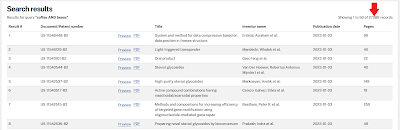
    Screenshot of results list from PPUBS Basic Search
    Over 27,000 results is a lot to review without tools to organize or refine
  3. There are no refining options once results are returned. Usually, this is not problematic in a simple search mode, but here it is. Without some basic limitation options at the start--specifically to search within the databases of patent application or granted patents post-1970--it means novice searchers could be confused about what results are for patents versus patent applications. I particularly dislike the inability to change how the list is ordered. Post-search refinements like these are usually the same in both simple/basic and advanced search modes.

Screenshot of a results list from Fondren's OneSearch simple mode, and the refinement options
Fondren's OneSearch provides results refinement, left side, in both simple and advanced modes
These are three primary problems that immediately stand out.
 
My verdict: I would not recommend using the new basic search for discovery or research. It seems most useful for finding patents the user already knows, and then with document number, inventor, assignee, or other specific information from the searchable fields. It is a poorly constructed tool for comprehensive searching.

The USPTO released this version in response to requests. While I understand that Patent Public Search, released last February, may initially have been overwhelming, it isn't any worse than previous advanced patent search tools from the USPTO. Presently, the new basic mode's primary advantage is its appearance--one markedly similar to other search tools. 

Maybe Fondren User Experience could provide a few pointers? Let's hope some improvements are made down the line.


Tuesday, January 5, 2021

USPTO year in review: New search tool, shorter examination times, and unexpected higher filing volume among highlights of 2020 for Patents and Trademarks

In an unprecedented year, both the Patents and Trademarks organizations worked tirelessly to ensure that the United States Patent and Trademark Office (USPTO) continued to improve its services for the innovation community.

Improved Patent Examinations

Patents continued its focus on improving the quality of patent examination:

  • The Patents End-to-End (PE2E)-Search Tool, a new patent search system, provides examiners with increased access to prior art. This tool currently provides examiners access to 39 million more foreign documents and full English translation documents than the current search tool (EAST/WEST); by April 2021, that number will increase to over 70 million. The search system can also integrate with an artificial intelligence-based tool to help examiners find more relevant prior art.
  • An updated performance appraisal plan for examiners provides a roadmap for enhanced patent quality, including an increased focus on search and the clarity of the written prosecution record.
  • Patent applications are now routed to examiners based on the correspondence of a technological profile of each application and each examiner’s work history profile.

Reduced Patent Examination Time

Under the leadership of Andrew Hirshfeld, who was reappointed as Commissioner for Patents in July 2020, the USPTO continued to reduce average patent examination time. The agency is now issuing final decisions—either allowing a patent or issuing a final rejection—on average within 23.3 months—faster than last year’s 23.8 months and significantly faster than in recent years. 

New Milestones for Trademarks

Under the leadership of the new Commissioner for Trademarks, David Gooder, who joined the agency in February 2020, the Trademarks organization saw several new milestones:

  • All-electronic processing of trademark applications rose to 88.7%, leading to more efficient processing, fewer errors, and more cost-effective transactions for USPTO customers.
  • The gains made in efficiency enabled Trademarks to meet pendency and quality performance goals for the 15th straight year, even as applications increased by 9.6% and operations shifted dramatically. The USPTO issued over 400,000 trademark registrations this year.
  • The Trademark Assistance Center answered 128,370 calls, a 10% increase over the prior year, and responded to 29,246 emails.
  • The organization advanced a number of initiatives to mitigate suspicious filings, fraudulent filings and specimens, and counterfeit products, including a joint anti-counterfeiting campaign with the National Crime Prevention Council (NCPC), post-registration audits to validate marks in use, and a new U.S. counsel rule that requires U.S.-based representation for applicants, registrants, or parties to a trademark proceeding before the USPTO.

For more information on the Patents and Trademarks organizations’ work this year, view the full USPTO FY 2020 Performance and Accountability Report (PAR) on the USPTO website.