Showing posts with label prior art. Show all posts

Wednesday, January 4, 2023

Basic Search Now Available

 Better late than never, some might point out: a new basic search mode for Patent Public Search, or PPUBS, was released mid-December. It wasn't given much publicity or announced before it was released, which led to a bit of confusion during a consultation here at the Kelley Center (the email announcement arrived a day or two later). 

At first glance, it appears fairly intuitive, if more similar to an advanced search one might see in a library catalog (like Fondren's) or a database/platform (like JSTOR). 

An image of the new PPUBS basic search mode
The new Patent Public Search Basic

Below the quick lookup for patent publication numbers, each search box has a drop-down menu with a fairly short list of common fields that don't require formatting like a suffix. Between the two search entry boxes is the drop-down menu of Boolean operators AND, OR, NOT. XOR and proximity operators have been excluded, which is understandable for a basic mode.

The brief set of query building instruction next to the search is about as long as possible for a basic mode, but it lacks explanation (or a link to one) of how Boolean operators work, which many people need.

Screenshot of the basic guidelines for query building in PPUBS
A few guidelines for building search queries
It is a strong start on a new design for a more basic, user-friendly search, but lacks a few key features that may alienate users:

  1. Only two search entry fields are available. Users cannot add more. This restricts searching, and will probably lead to lengthy, overwhelming results lists (high recall, low precision).
  2. There is no clear way to download, save, or print a list of search results. I am frequently asked if it is possible to download results lists in Excel-friendly formats. Many people want to use Excel to refine or organize results, rather than changing search queries. This tool's limitation to two search term boxes may make organizing or refining results in another program necessary. Furthermore, keeping track of searches and results is extremely important in any patent search, basic or advanced. 
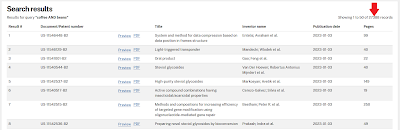
    Screenshot of results list from PPUBS Basic Search
    Over 27,000 results is a lot to review without tools to organize or refine
  3. There are no refining options once results are returned. Usually, this is not problematic in a simple search mode, but here it is. Without some basic limitation options at the start--specifically to search within the databases of patent application or granted patents post-1970--it means novice searchers could be confused about what results are for patents versus patent applications. I particularly dislike the inability to change how the list is ordered. Post-search refinements like these are usually the same in both simple/basic and advanced search modes.

Screenshot of a results list from Fondren's OneSearch simple mode, and the refinement options
Fondren's OneSearch provides results refinement, left side, in both simple and advanced modes
These are three primary problems that immediately stand out.
 
My verdict: I would not recommend using the new basic search for discovery or research. It seems most useful for finding patents the user already knows, and then with document number, inventor, assignee, or other specific information from the searchable fields. It is a poorly constructed tool for comprehensive searching.

The USPTO released this version in response to requests. While I understand that Patent Public Search, released last February, may initially have been overwhelming, it isn't any worse than previous advanced patent search tools from the USPTO. Presently, the new basic mode's primary advantage is its appearance--one markedly similar to other search tools. 

Maybe Fondren User Experience could provide a few pointers? Let's hope some improvements are made down the line.


Friday, December 18, 2020

Advances in searching for prior art

Blog by Andrei Iancu, Under Secretary of Commerce for Intellectual Property and Director of the USPTO and Drew Hirshfeld, Commissioner for Patents of the USPTO  

Patent examination, though inherently complex, is in large part a fact-finding mission with the goal of providing predictable and reliable intellectual property rights. The prior art search is the foundation for achieving this mission.

Keep Reading.

Wednesday, May 9, 2018

Inventor Info Chat

Join us May 17 from 11 a.m. to noon ET for our Inventor Info Chat webinar “Prior art and its use in determining patentability."
This presentation is for inventors who want to understand what examiners at the USPTO consider to be prior art and how prior art is used in official correspondence to applicants.  
More information, including how to attend, is available on our Inventor Info Chat event page on the USPTO website.

Wednesday, December 6, 2017

Patent Trial and Appeal Board Presents

Best practices for presenting prior art and proving a document as a printed publication

Join PTAB for a Boardside Chat on Thursday, December 7, 2017 from 12-1 p.m. ET.
The program is free to attend.  Discussion topics include best practices for presenting prior art and proving a document is a printed publication.  Judges Lora Green and Brian McNamara will present and receive audience questions.  This topic is relevant for both ex parte appeal and AIA trial proceedings.  

The webinar is free and open to everyone. Here are details for viewing the program.

Wednesday, March 19, 2014

Roundtable - 3rd Party Preissuance Submissions to Identify Relevant Prior Art

According to a Federal Register Notice of March 19, 2014 (Volume 79, Number 53,Pages 15319-15321), the USPTO is hosing a "Roundtable Event on the Use of Crowdsourcing and Third-Party Preissuance Submissions To Identify Relevant Prior Art."

SUMMARY: The United States Patent and Trademark Office (Office) is hosting a roundtable event to solicit public opinions regarding the use of crowdsourcing and third-party preissuance submissions to identify relevant prior art and enhance the quality of examination as well as the quality of issued patents. Members of the public are invited to participate. The roundtable will provide a forum for an informal discussion of the topics identified in this notice. Written comments in response to these topics also are requested.

DATES: Event: The roundtable event will be held on April 10, 2014,beginning at 12:30 p.m. Eastern Daylight Time (EDT), and ending at 5:00p.m. EDT.
Registration: Registration to attend the roundtable in person or via webcast is required by April 4, 2014. Additionally, members of the public who wish to participate in the roundtable as a speaker must do so by request in writing no later than March 27, 2014. See the ``Event Registration Information'' section of this notice for additional details on how to register.

Monday, January 6, 2014

Comments Sought About Prior Art Resources for Software-Related Patent Applications

In a Monday, Jan. 6, 2014 Federal Register Notice, the USPTO is requesting comments about prior art resources used in the examination of software-related patent applications as mentioned in the following summary:

SUMMARY: The United States Patent and Trademark Office (USPTO) has formed a partnership with the software community to enhance the quality of software-related patents (Software Partnership). The Software Partnership is an opportunity to bring stakeholders together through a series of roundtable discussions to share ideas, feedback, experiences, and insights on software-related patents. On December 5, 2013, as partof the Software Partnership, the USPTO hosted a roundtable discussion on the USPTO's prior art searching techniques and tools. At the roundtable, the USPTO spoke on the prior art resources currently utilized by examiners and listened to external speakers and the public on additional prior art resources and improved search techniques. In order to receive further feedback from stakeholders, the USPTO is requesting comments on the questions regarding prior art resources and search techniques set forth below.

For more information visit http://www.gpo.gov/fdsys/pkg/FR-2014-01-06/html/2013-31492.htm

Monday, August 27, 2012

Prior Art/International Search Via Google

Google has introduced a prior art search tool to search journal articles, books, and trade publications in addition to patents. Once you've done a search and opened a result page, look for the blue "Find prior art" box at the top.
Google is also now searching patents from the European Patent Office. For more information about the international patent search and the prior art search tool, see the Google blog entry, Improving Google Patents with European Patent Office patents and the Prior Art Finder.
For a more definitive classification search of international patents, Fondren Library is now offering a one-hour introductory class about how to search for international patents online using the European Patent Office Espacenet interface directly. For class times call 713-348-5483 or access the patent searching class schedule.
A tutorial for using PubWest to search for both U.S. and international patents is also loaded on a library computer used for accessing PubWest.

Thursday, September 18, 2008

Peer-to-Patent Program

The USPTO has launched a new program that may reduce patent litigation. The Peer-to-Patent program uses a limited number of volunteer applicants who have applications in the computer arts field. The applications will be posted on a Peer-to-Patent website to be analyzed by members of the public. This will help determine whether an invention already exists or is obvious. For a discussion of this new program, see the USPTO's statement and a CNN article.