Showing posts with label U.S. women inventors. Show all posts

Monday, August 7, 2023

I'm a Barbie Girl, in an IP World

Alright, let's hop on this Barbie bandwagon. Better late than never.

For those who might not know, Barbie has a lot of IP. Like, a truly impressive amount in multiple categories. Patents? Yep. Trademarks? Huge check. Copyright? You know it. Trade secrets? One can only assume.

That means this blog post will have to choose some small portion... We've looked at patents for most of the summer, so let's investigate the evolution of one of Barbie's trademarks.

A trademark for the name/designation Barbie, as applied to a doll, was first issued in 1964. It's been renewed multiple times since then, most recently in 2014. The first registration number was 0068905.
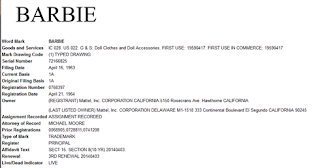
The image shows a record from the TSDR for the original Barbie work mark
The TSDR record for the original Barbie mark
Of course, this does not include any specific text colors or appearance; that came later. The semi-cursive, pink script (that you're hopefully imagining) first appeared in the 1990s, much later than I thought. The registration certificate for mark no. 2110856 doesn't show it, but the mark is for white script on a pink background "and is lined for the color pink". Unfortunately, documentation available from the TSDR does not include more than the registration certificate, so no specimen or official color drawing is available to show here.
A black and white image of the script and line background for the trademark from from reg. no. 2110856's certificate
The image from reg. no. 2110856 certificate
According to the application, it was first used in 1992 for dolls, doll clothing and doll accessories. Mark no. 2110856 was registered in November, 1997 and cancelled in August of 2004. Evidently, it was cancelled because "registrant did not file an acceptable declaration under Section 8". This refers to Section 8 of the U.S. Code regulating trademarks. No documentation on the cancellation is available via TSDR, so further research would be required to learn more about the context.

There were several Barbie script marks submitted for registration in the 90s; two are still live, each renewed within the last ten years. Registration nos. 2087842 and 2639971 were filed in 1996 and 1998, and granted registration in 1997 and 2002 (both sets of dates respectively). 

A picture of an original-style Barnie doll in a box, used for the specimen image accompanying reg. no. 2087842
Specimen image accompanying reg. no. 2087842
You've likely noticed 2087842 was filed around the same time as the cancelled 2110856; it is also used for the same goods (dolls, doll clothing and doll accessories). Color is not specified in the mark description.

2639971, however, is lined for pink like 2110856, but the goods associated are clothes, costumes, athletic wear, and other garments.

A picture of a t-shirt that reads "Barbie dumped Ken" using the "Barbie" trademarked script protected by reg. no. 2639971
"Barbie" uses the trademarked script protected by reg. no. 2639971. But did Barbie really dump Ken?
Another dead mark, registration no. 2635578, has script similar to 2110856, without the lined cloud-shaped background or specified colors. Filed in 1997, it was registered in 2002, and cancelled in 2009. The associated goods were bath products and cosmetics intended for little girls.
An image of the sciprt and word Barbie used for the certificate image for cancelled mark no. 2635578
Certificate image of the script for cancelled mark no. 2635578
In 2008, Mattel filed for another Barbie script mark, no color specified, again for goods that included dolls, their clothes and accessories, as well as several other types of toys and playthings. Registered in 2010, no. 3737763 was cancelled in 2016, once more under Section 8. To read the details on that, visit the TSDR page.
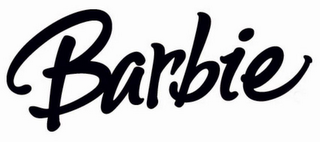
An image of the sciprt and word Barbie used for the certificate image for cancelled mark no. 3737763
Certificate image of the script for cancelled mark no. 3737763
Finally, Mattel applied for one more Barbie script mark in 2021, published July 11, 2023. Serial no. 90509941 doesn't claim a specific color, but the goods associated are, unsurprisingly, dolls and toy figures. It is no stretch of the imagination to guess that this slightly altered script intentionally matches the style from the Barbie movie. 

An image of the sciprt and word Barbie used for the certificate image for filed serial no. 90509941
Look familiar?
Just looking at the Barbie scripts should provide some indication of the amount of marks and other IP owned by Mattel for Barbie. Hundreds of word marks were sorted through to find this short list of specific scripts. The Barbie IP Empire is massive and generates billions in income.

BONUS: The first Barbie patent was not for the doll's design, but mostly for its construction that allowed it stand upright with the help of pins. Barbie was originally created with feet that couldn't support the doll. Evidently that's changed, but it was after I stopped regularly encountering them. 

An image taken from US Patent no. 3009284 showing the construction of a Barbie that allowed her to stand
"If my feet were shaped like this, I'd never wear heels!"


Tuesday, March 21, 2023

Women Inventors of 1990s Rice

Happy Women's History Month! March has a number of interesting national days and dedications, but women's history is among the most prominent, and perhaps even important.

This blog celebrates some of the leading women in Rice's early(-ish*) history of patents and inventors. Rice's first surge in patenting university research/inventions took place in the 1990s. While there is definitely a direct relationship to the work of Dr. Smalley, several women made their own significant contributions. 

First, Dr. Alemka Kisic, formerly of the Biosciences department. She is the first woman inventor credited on a Rice-assigned patent, in 1990. She, along with three others, invented US 4,897,475: Process for synthesis of 5α-cholest-8(14)-en-3/β-ol-15-one and other 15-oxygenated sterols. 

Image from US Patent 4,897,475
Molecular diagrams from US Patent 4,897,475

Dr. Kisic was even more influential outside her role as inventor. Rice annually awards the Dr. Alemka Kisic Distinguished Staff Service Award from the Department of Biochemistry and Cell Biology "in recognition of exceptional leadership and devoted service" to two department members. 

Dr. Linda Torczon is the second woman on a Rice-assigned patent. She and three others invented US 5,249,295: Digital computer register allocation and code spilling using interference graph coloring.

Process flowchart from US Patent 5,249,295
In addition, Dr. Torczon earned all three of her degrees from Rice during the 1980s, and has been a part of the computer science department since 1985. Dr. Torczon's impressive dedication and loyalty to Rice computer science is paired with her outreach efforts focused on increasing the representation and presence of women and underrepresented minorities in science, especially computer sciences.  

The third woman credited on a Rice-owned patent is Dr. Laura Suggs, who worked on a Rice-owned patent while studying for her Ph.D. in chemical engineering, which was awarded in 1998. She was the lead inventor on US 5,644,005: Method of making poly(propylene fumarate-coethylene oxide). 

Molecular diagrams from US Patent 5,644,005

Presently, Dr. Suggs holds UT's biomedical engineering department's Zarrow Centennial Professorship in Engineering. She is a credited inventor on other patents, such as US 6,355,755, granted in 2002.

The last female inventor on a Rice-owned patent from the 1990s is Dr. Yildiz Bayazitoglu, lead inventor of US 5,887,018: Longitudinal electromagnetic levitator. 

Schematic representation of magnetic flux density from US Patent 5,887,018

Dr. Bayazitoglu was the inventor on an earlier patent, US 5,527,136: Mono-tripod platform, but it is assigned to the Halliburton Company. She also is credited as an inventor on two later patents issued to Rice, US 7,323,136 and US 8,034,134, which can be found in the Digital Scholarship Archive patent repository. 

She is still Rice's Harry S. Cameron Professor in Mechanical Engineering.

Tuesday, March 23, 2021

Women's History Month: Valiant Women of the Vote -- Ellen Ochoa

In the century since the 19th Amendment was ratified, the stories of suffragists continue to inspire generations of women trailblazers. Inventor and astronaut Ellen Ochoa carried this legacy with her to the final frontier – space! 
 
An engineer, Ochoa holds several patents in the field of optical systems for information processing. Her inventions include a system that detects defects in a repeating pattern, an object recognition method, and a method for image noise removal. At @NASA, she led a group researching the use of optical technology for automated space exploration. 
 
In 1993, Ochoa became the first Hispanic woman to go into space when serving on the crew of the Space Shuttle Discovery, a mission tasked with studying the Earth’s ozone layer. On a subsequent mission six years later, Ochoa brought an original gold, white, and purple suffrage banner into orbit. Ochoa has been in space four times and logged over 1,000 space hours. She went on to serve as the 11th director of the Johnson Space Center and is a recipient of NASA’s Distinguished Service Medal. 
 
Learn more about Ochoa’s historic flight from the @National Archives: http://bit.ly/3rUmQe5 #WomensHistoryMonth #ValiantWomenOfTheVote

Thursday, March 4, 2021

Women's History Month Series: Valiant Women of the Vote -- Harriet Strong

Inventor, entrepreneur, and suffragist Harriet Strong’s efforts to keep her 220-acre farm productive led to advances in agriculture and irrigation for the entire nation. 
 
Following her husband’s death in 1883, Harriet Strong became the sole owner of Rancho del Fuerte, a failing farm in Whittier, California. Determined to turn her family’s fortunes around, Strong threw herself into learning about water, soil, and marketing. She solved her immediate need for income by planting fast-growing Argentine pampas grass, an economical alternative to bird feathers for decorating hats. A creative saleswoman, Strong convinced both the Democratic and Republican national conventions to purchase plumes, dyed red, white, and blue, to wave patriotically on the convention floor. Although her gender barred her from voting in national elections, this suffragist’s crops were on full display during both the 1892 and 1896 conventions.
 
Thinking of her farm’s long-term future, Strong invested in a lucrative walnut crop. To ensure the health of her thirsty walnut trees, Strong invented an elaborate system of water control and irrigation. Los Angeles was prone to flash floods, and she was able to capture the water from these storms and store it for later use. Strong received U.S. patent number 374,378 for her dam and reservoir construction in 1887, and her invention was the basis for transformative national projects, including the Hoover Dam. Building on her success, Strong became an advocate for business training for women.

Tuesday, August 18, 2020

Centennial of the 19th Amendment

Dear colleagues,

Today marks a monumental milestone in the journey toward equal rights for women in the United States. One hundred years ago, on August 18, 1920, Tennessee became the 36th state to ratify the 19th Amendment to our Constitution, which granted women the right to vote. With the required approval of three-fourths of the states secured, the Amendment went into effect on August 26 of that year.

This victory would not have been possible without the efforts of suffragists from diverse communities across the nation. For example, Lyda Newman organized an African American branch of the New York Woman Suffrage Party, actively canvassed neighborhoods, and led suffrage meetings in her voting district.

Newman was also an inventor. In 1898, she received U.S. Patent No. 614,335 for a hairbrush that was more efficient and hygienic than existing designs. It was comprised of evenly spaced rows of bristles, with open slots to guide loose hair or impurities into a recessed compartment that users could easily remove and clean out.

In the century since, our nation has made great strides in guaranteeing equal opportunities for women. As we found in our recent report, “Progress and Potential: 2020 update on U.S. women inventor-patentees,” more women are now entering and staying engaged in the patent system, and the gender gap is closing. But there is much more work to be done.

When it comes to expanding the innovation ecosystem, the USPTO is leading the way. Among other efforts, we are partnering with colleagues in other government agencies, as well as industry and academia, to find ways to increase the number of female inventors. We are also highlighting the accomplishments of past and present female inventors, like those featured in our Journeys of Innovation series, to inspire future generations of women to innovate.

As we celebrate the centennial of the 19th Amendment’s ratification, I want to thank you for supporting diversity of innovation and diversity among our own ranks here at the USPTO. Your efforts are making the process of invention more accessible and ensuring our nation’s position as a leader in the global innovation community.


Andrei Iancu

Under Secretary of Commerce for Intellectual Property 
and Director of the United States Patent and Trademark Office


Monday, August 3, 2020

What others are saying about the USPTO’s updated study on participation of women in the U.S. innovation economy

On Tuesday, July 21, the United States Patent and Trademark Office released “Progress and Potential: 2020 Update on U.S. Women Inventor-Patentees,” a follow-up to its 2019 report on U.S. women inventors. The new report found that more women are participating in the intellectual property system than ever before. A brief roundup of reactions to this report includes:

CNET–Women inventors are sticking with it, patent office says

“The percentage of women inventors filing additional patents within five years of their first is on the rise. Data from the United States Patent and Trademark Office shows improvement in the patent field for women since the 1980s.”

Bloomberg–Women Inventors Make Progress but Still Lag Male Counterparts

“American women are making slow but steady progress when it comes to innovation and obtaining legal protection for their inventions, according to a new study by the U.S. Patent and Trademark Office. The share of patents with at least one woman named as inventor was 22% by the end of 2019, up from 20.7% in 2016, according to the study of patents with at least one U.S.-based inventor.”

Protocol–The U.S. Patent and Trademark Office has new figures on the gender diversity of people winning patents

“…the percentage of women inventors has grown: It stood at less than 5% in 1980, whereas women accounted for more than 17% of the inventors on U.S. patents in 2019. The percentage of women on patents is also up in 45 states when comparing 2007 to 2016 and 2007 to 2019, the USPTO report said.”

World IP Review–USPTO welcomes ‘promising’ women inventor numbers

“USPTO welcomes ‘promising’ women inventor numbers. A new report from the US Patent and Trademark Office reveals that the participation of women in innovation is growing, earning the office praise from the legal industry.”

Law360–USPTO Says Rate Of Women Getting Patents At 'All-Time High'

The report released Tuesday—which focused on women who secured patents in the last three years—found that the rate in which female inventors are participating in the U.S. patent system is at an "all-time high," from 12.1% in 2016 to 12.8% in 2019.

Innovation Alliance–Innovation Alliance Statement on Update to USPTO Report on Women Inventors on U.S. Patents

“The Innovation Alliance commends USPTO Director Iancu and his staff for releasing an update to the 2019 USPTO report on the participation of women in the U.S. innovation economy.”

Andrei Iancu, Under Secretary of Commerce for Intellectual Property and Director of the USPTO

“To retain our nation’s edge as a global innovation leader, we need even broader participation in patenting. That’s why the USPTO has made outreach to underrepresented groups a top priority.”

This report updates the previous findings based on a review of an additional nearly one million issued patents and three years of new data, and it provides further insights into the participation of women in America’s intellectual property systems.

Read the press release on the USPTO website.

Thursday, July 23, 2020

USPTO releases updated study on participation of women in the U.S. innovation economy

The United States Patent and Trademark Office (USPTO) today released “Progress and Potential: 2020 Update on U.S. Women Inventor-Patentees,” a follow-up to its 2019 report on U.S. women inventors. The new report updates the previous findings based on a review of an additional nearly one million issued patents and three years of new data, and it provides further insights into the participation of women in America’s intellectual property systems.

The report's numerous findings include:

  • More women are entering and staying active in the patent system than ever before.
  • The number of patents with at least one woman inventor increased from 20.7% in 2016 to 21.9% by the end of 2019.
  • The “Women Inventor Rate”–the share of U.S. inventors receiving patents who are women–increased from 12.1% in 2016 to 12.8% in 2019.
  • The share of women among new inventors on issued patents increased from 16.6% in 2016 to 17.3% by 2019.
  • The gender gap in the number of women inventors who remain active by patenting again within five years is decreasing. For the most recent group of new inventors, 46% of women patented again in the next five years versus 52% of men.
  • Among the leading patent filers, the 3M Company showed the largest improvement in the participation of women inventor-patentees: Their average increased from 15.2% over 2007- 2016 to 16.6% for 2007-2019.  

“This report is a great achievement for the USPTO and an important steppingstone for women in America’s intellectual property systems,” said Secretary of Commerce Wilbur Ross. “The USPTO has remained committed in their efforts to support women in innovation, and this positive momentum will continue to create a more inclusive intellectual property community.”

“Today’s report from the USPTO further highlights the important contributions of women to American innovation,” said Deputy Secretary of Commerce Karen Dunn Kelley. “I applaud the USPTO for their support of women inventors and their work to encourage women to take advantage of our nation’s intellectual property protections, the gold standard for the world. Everyone benefits when women fully participate in our innovation ecosystem.”

“The good news is that efforts to increase the participation of women in the intellectual property system continue to yield results,” said Andrei Iancu, Under Secretary of Commerce for Intellectual Property and Director of the USPTO. “To retain our nation’s edge as a global innovation leader, we need even broader participation in patenting. That’s why the USPTO has made outreach to underrepresented groups a top priority. We will continue to work with industry and academia to expand participation in the innovation ecosystem. We will also shine a spotlight on the accomplishments of past and present women inventors, and inventors from other underrepresented groups, to inspire a new generation to participate in innovation." 

Access the full report on the USPTO website.