Showing posts with label international patent. Show all posts

Friday, September 12, 2025

The Labubu, the Lafufu, and Intellectual Property Wars

If you haven't heard about the Labubu yet, you must be very disconnected. Aside from being a recent craze among youth and the trendy, they've appeared in TV shows, in various unsanctioned forms, and in the news. Most of us have heard about the Labubu and their counterfeit counterparts, frequently known as "Lafufu".

For those of you who somehow have managed to remain oblivious, first, let me congratulate you on your commitment to that. Second, let me introduce you to what I've started thinking of as the latest Beanie Baby (because that was my childhood's out-of-control craze). These plush toys come in all sizes and are collectively known as "The Monsters". They embody the concept of grotesque-cute, having cute cuddly animal bodies, chubby cheeks, and aggressively lowered eyebrows and (exactly 9) bared, pointed teeth. 

A soon-to-be-released Labubu, selling for $299.99. Image taken from Pop Mart website.
Now, I am not writing this post because it struck me as a good idea or piqued my IP interests like usual, but because I was asked a specific question regarding the Labubu/Lafufu relationship by a friend of mine. And, as always, something simple quickly became complex, because IP is like that. 

Let's start with paraphrasing her question. She wanted to know why there were so many fake Labubus on the market, and why their manufacturer didn't secure exclusive rights via design patent. [I'd like to briefly redirect things to point out that I have managed to teach people around me so much about IP! There's no way she would have been aware of design patents and their purpose if I hadn't talked about them enough.] She also wondered how it was possible for some counterfeits to be so faithful to the original product as to be almost impossible to differentiate. After all, who hasn't, over the years, seen a dupe of  designer brand with some kind of misspelling or inverted logo to try to dodge infringement? Yet some Lafufu might as well be made in the same factory by the same people, they are so accurate. 

[Side note: I recognize it is possible some are stolen from authorized factories and sold off-brand, I am not going to focus on that.]

My friend's question has multiple answers, the first of which is fairly easy. One of the aspects of Labubus that makes them so collectible are the many different varieties, some of which are rare, and must be bought "blind" in concealed packaging. This drives the desire to buy more, enhancing the feeling rarity and specialty when found. It's strategic marketing but makes a design patents almost impossible. Because these differences are in appearance, and design patents protect specific appearances, each Labubu would need its own separate patent (at least in the US). Since there are varieties are multitudinous, and with new versions introduced and potentially released for a limited time, pursuing design patents for the full range would be wasteful. The cost, in both time and money, would outweigh the benefits. ROI: probably negative.

The second answer, and at a sort of intermediate level, is their international marketing. A design patent can only be enforced in the jurisdiction where it was issued. So not only would they need many different iterations to protect all the different designs, they would also need to pursue them across many patent offices. No real global patenting office exists; just treaties to help ease the process of transferring applications from one granting body to another.

At this point, if you're thinking about the possibility of some kind of trademark on an international scale, or perhaps trade dress for the Labubu, you'd be closer to a potential answer--if the company Pop Mart (owners of Labubu) wanted to represent their whole brand with the Labubu or The Monsters. As best as I could find, they have many registered marks in many jurisdictions, including "The Monsters" and "Labubu", but that mostly just protects them against other entities identifying the source of the sales as Pop Mart or their Labubu. Their attempts at using the trademarks haven't been effective. 

A logo owned by Pop Mart, found on WIPO
This actually brings us close to the third answer of why there are so many Lafufus of varying quality and correctness. Enforcing a brand on a global scale is challenging at the best of times, but when you have a fast-selling sensation it is even harder, because counterfeits pop up and disappear as quickly as the real merch. And if they don't have the right kind of claim attached to their Lafufu, it might not quite be infringement. 

More than that, the company Pop Mart and the Labubu originate in China. And China is not known for being terribly strict enforcers of IP rights holders. In fact, you wouldn't be blamed for thinking that China is one of the top sources of fraudulent, infringing goods sold worldwide. The government does not have a good reputation for protecting foreign IP holder rights in China, or for staunching the flow of fake goods from their country into others. 

Since they might even have a chunk of their national income derived from these fakes, trying to suddenly enforce the IP rights of a massive sensation might be difficult. Not that the government isn't trying; they are, in fact, attempting to do their best to control it. 

Beyond that, many consumers, quite frankly, don't care if they are buying Lafufus. They know they're fakes and still purchase them. Some revel in the weirdness of the fakes and the variations they present on the original. That makes it even harder to stop their production, when the demand for a fake might justify the risks of setting up a more permanent operation.

Yet another complication? I've read that two of the best sources for a Lafufu are Shein and Alibaba, which are Chinese-owned online sales companies. They can't enforce Labubu IP within their own borders.

It extends beyond that, though. These are just the three most obvious and accessible answers for why the Lafufus seem to run unchecked.  


Meanwhile... I can only imagine the schadenfreude certain IP enforcers are feeling as China's IP enforcement struggles to crack down on counterfeits and their circulation.  

Friday, September 6, 2024

The Mouse Rug

It's kind of fun, when you notice something new on an old item. For example, take a look at something I just recently noticed about my Mouse Rug, a rug-style mouse pad that I received as a gift well over a decade ago. [This was, of course, at a time when more people used a computer mouse and unique mouse pads were still something. After all, some of us still relied on the mechanical model that had an actual ball (taking the ball out and then reassembling the mouse so your parents didn't notice was a great way to make them mad).] It now serves as a trivet, and when I was cleaning it after a spill at dinner, I noticed what it said on the back for the first time:

Underside of the tiny rug replica
That's right, patented worldwide! What a claim. And, as your friendly patent and trademark librarian, I had to find out if this claim was true.

Friday, April 26, 2024

Flowbee: As Seen on TV (in 1989)

In a recent conversation with my husband, I mentioned that I needed to give some of my plants a "haircut", but I wasn't sure how to accomplish it. He facetiously recommended I use a Flowbee, and I responded with something along the lines of "Duh whuh?"

He proceeded to try to explain the concept of some kind of vacuum cleaner hair cutter device to me, without the aid of visuals, in a rare moment we were both without our phones. Very little was clarified except that it was fairly well known in the 1980s, mostly through TV advertisements. 

Later, once we were again fully plugged in and had phones available, he showed me a few YouTube videos--including this one I can't embed--that made sense of things, including some 80s and 90s hairstyles. Equipped with a better understanding of a Flowbee, I finally got the joke. But my mind was, of course, drawn to speculating on its IP.

The vacuum hair hero; image taken from flowbee.com
Despite my husband's immediate assurances, I wondered if it was patented.

Turns out, the guy behind the Flowbee™ has his IP locked down.

I'm telling you, not even Rice is this careful about international coverage. 

Yes, it also has trademarks, and this is the official specimen on record
Rick Hunts, the inventor of the Flowbee™, obtained his initial patent for "Hair Clipper" in 14 different jurisdictions, likely through this WIPO patent application. The patent was granted in at least 7 of those, including Germany (twice, potentially reflecting the geopolitical status in the 1980s), Australia, Canada, and the European Union. The US Patent for the Hair Clipper, US 4,679,322, was granted in July of 1987... shortly before I was born. 

There are a few other Flowbee™-related patents that were filed and granted later. These, I presume, are for improvements or new accoutrements, judging by the names "Grooming Attachment for Vacuum-Drawn Clippers", "Vacuum-Drawn Hair Clipper", and "Vacuum-Powered Hair Cutting Guide". All were filed within a few years after the initial hair clipper, but seemingly only in the US. Who knew a vacuum-enabled hair clipper could have so many improvements?

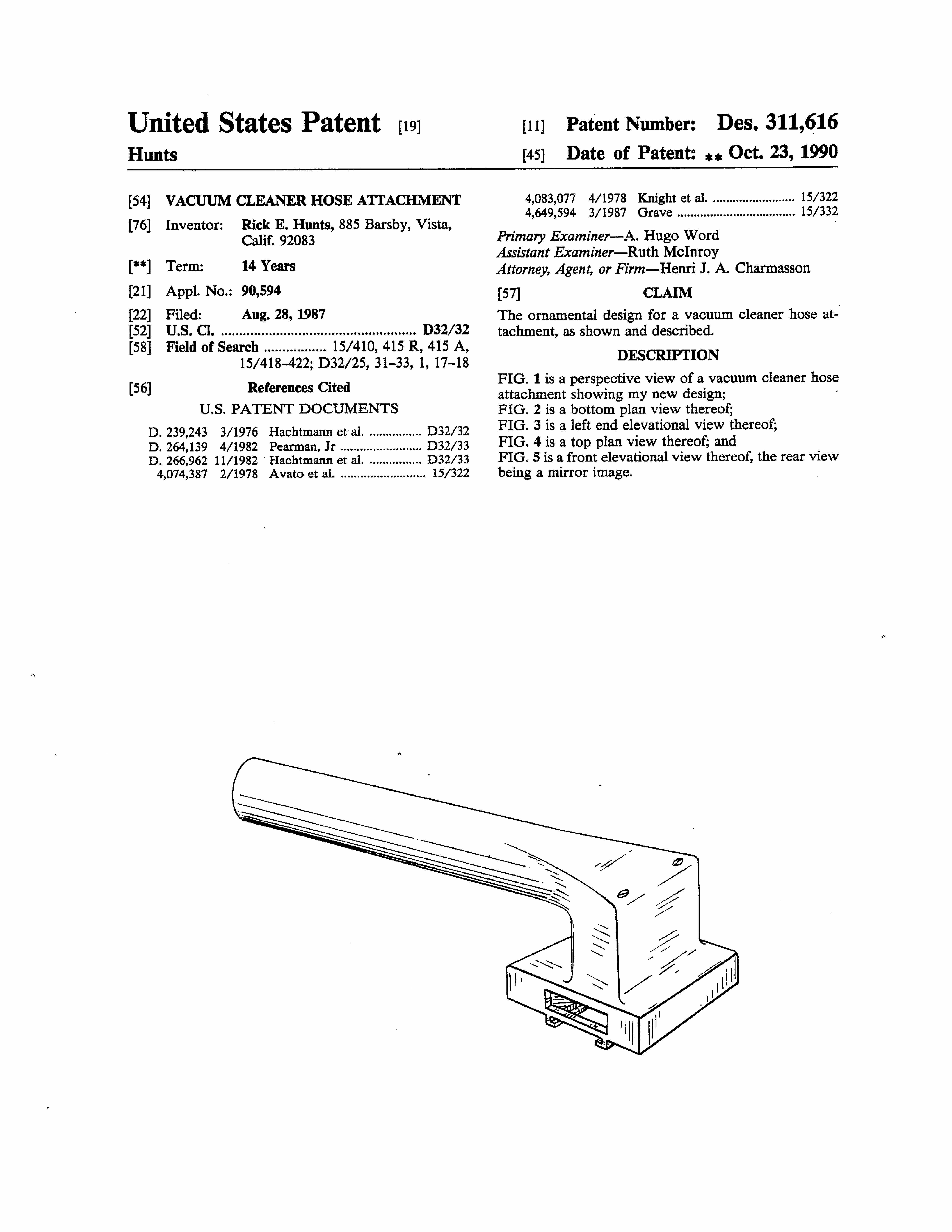
Hunts also owns a design patent in the US for the "Vacuum Cleaner Hose Attachment", D311,616. 

Apparently a distinct ornamental design
Today, all of the Flowbee™ patents have expired, so it's possible there are many versions available. 

And, as it turns out, I could have used one adapted for plants, because my pruning was a mess.

Tuesday, April 14, 2020

Patent Quality Chat: International Patent Cooperation Initiatives

Please join the USPTO for the second 2020 Patent Quality Chat webinar, “International Patent Cooperation Initiatives,” on April 21 at noon ET. Learn how we engage in various work-sharing programs and initiatives that bring multiple office examination efforts together. We will discuss how these efforts improve patent examination quality and timeliness while reducing stakeholder costs. We will also share details about our new Parallel Patent Grant program with Mexico, our Collaborative Search Pilot program, and the Global Dossier.
View the event listing on the USPTO website for more information, including how to attend.
Please send your input and questions to patentquality@uspto.gov before and during the event.
The Patent Quality Chat webinar series is presented as a part of our continuous efforts to improve patent quality.  

Tuesday, October 22, 2013

Changes to Implement the Patent Law Treaty

The Monday, Oct. 21, 2013 (pages 62367-62409) Federal Register presents a final rule entitled Changes To Implement the Patent Law Treaty; Final Rule. The summary follows:
SUMMARY: The Patent Law Treaties Implementation Act of 2012 (PLTIA)amends the patent laws to implement the provisions of the Hague Agreement Concerning International Registration of Industrial Designs(Hague Agreement) in title I, and the Patent Law Treaty (PLT) in title II. The PLT harmonizes and streamlines formal procedures pertaining to the filing and processing of patent applications. This final rule revises the rules of practice for consistency with the changes in the PLT and title II of the PLTIA. The United States Patent and Trademark Office(Office) is implementing the Hague Agreement and title I of the PLTIA in a separate rulemaking. The notable changes in the PLT and title II of the PLTIA pertain to: The filing date requirements for a patent application; the restoration of patent rights via the revival of abandoned applications and acceptance of delayed maintenance fee payments; and the restoration of the right of priority to a foreign application or the benefit of a provisional application in a subsequent application filed within two months of the expiration of the twelve-month period (six-month period for design applications) for filing such a subsequent application. This final rule also revises the patent term adjustment provisions to provide for a reduction of any patent term adjustment if an application is not in condition for examination within eight months of its filing date or date of commencement of national stage in an international application, and contains miscellaneous changes pertaining to the supplemental examination, inventor's oath or declaration, and first inventor to file provisions of the Leahy-Smith America Invents Act (AIA).
For more information: http://www.gpo.gov/fdsys/pkg/FR-2013-10-21/html/2013-24471.htm

Monday, October 7, 2013

Madrid Protocol Training for Advanced Users

Notice from the USPTO's PTRC Office:

The United States Patent and Trademark Office (USPTO) on Wednesday, October 23, 2013 at its headquarters in Alexandria, VA. will hold a one-day seminar on using the Madrid Protocol. This seminar targets practitioners who are familiar with and have used the Madrid Protocol. The purpose of the seminar is to provide practical information on common issues as well as maintaining and managing the resulting international registration. Seminar highlights include: WIPO resources; issues to consider when preparing to file and actually filing an international application; the USPTO review process for certification of the international application; International Bureau review of the international application; and issues related to changing and renewing the international registration. A detailed agenda will be provided at a later date.

To attend in person, please send your name to TMFeedback@uspto.gov no later than c.o.b. Friday, October 18, with the subject line "Madrid Protocol advanced training."

Webcast instructions and agenda, are now available at http://www.uspto.gov/trademarks/notices/Madrid_Protocol_Seminar.jsp. Registration is not needed if you only plan to view the webcast. If possible, the USPTO will attempt to make a version available for viewing at a later time.

Monday, August 27, 2012

Prior Art/International Search Via Google

Google has introduced a prior art search tool to search journal articles, books, and trade publications in addition to patents. Once you've done a search and opened a result page, look for the blue "Find prior art" box at the top.
Google is also now searching patents from the European Patent Office. For more information about the international patent search and the prior art search tool, see the Google blog entry, Improving Google Patents with European Patent Office patents and the Prior Art Finder.
For a more definitive classification search of international patents, Fondren Library is now offering a one-hour introductory class about how to search for international patents online using the European Patent Office Espacenet interface directly. For class times call 713-348-5483 or access the patent searching class schedule.
A tutorial for using PubWest to search for both U.S. and international patents is also loaded on a library computer used for accessing PubWest.

Monday, October 10, 2011

International Patent Protection for Small Businesses

[Federal Register Volume 76, Number 195 (Friday, October 7, 2011)]
[Notices][Pages 62389-62391][FR Doc No: 2011-26157]

DEPARTMENT OF COMMERCE
United States Patent and Trademark Office
[Docket No.: PTO-P-2011-0062]

Request for Comments and Notice of Public Hearings on the Study of International Patent Protection for Small Businesses

The United States Patent and Trademark Office (USPTO) is interested in gathering information on international patent protection for small businesses for purposes of preparing a report on the subject as required by the America Invents Act. To assist in gathering this information, the USPTO is holding a public hearing at which interested members of the public are invited to testify on this topic. In addition, members of the public may submit written comments.

Public Hearing: The USPTO will hold two hearings in support of the study of international patent protection for small businesses. The first public hearing will be held on October 27, 2011, beginning at 1 p.m. Eastern Daylight Time (EDT) and ending at 4 p.m. EDT. The first public hearing will be held at the USPTO in the Madison Auditorium on the concourse level of the Madison [[Page 62390]] Building, located at 600 Dulany Street, Alexandria, Virginia 22314. The second public hearing will be held on November 1, 2011, beginning at 9 a.m. Pacific Daylight Time (PDT) and ending at 12 p.m. PDT. The second public hearing will be held at the University of Southern California in the Gould School of Law, located at 699 Exposition Boulevard, Los Angeles, California 90089.

To see the complete text of this comment request including sample questions to assist in gathering information, access: http://frwebgate.access.gpo.gov/cgi-bin/getdoc.cgi?dbname=2011_register&docid=2011-26157.

Tuesday, November 2, 2010

U.S./European Joint Patent Classification System

According to an Oct. 25, 2010 press release, the United States Patent and Trademark Office (USPTO) and the European Patent Office (EPO) are working to establish a joint patent classification system. The new system will align the U.S. and EPO classification systems with the International Patent Classification (IPC) system administered by the World Intellectual Property Organization (WIPO). To improve searching capabilities the new system will be more detailed than the present IPC.

Friday, June 11, 2010

Scam - Payment of Fees for International Patents & Trademarks

The Patent Baristas June 9, 2010 blog entry contains a warning about unsolicited mailings to applicants and owners of international patents, designs and trade marks inviting them to enter their intellectual property in various registers, publications, or databases for a fee. The mailing are in official looking envelopes and come from official sounding organizations.  To read more about these scams, access "A Warning About Requests for Payment of Patent Fees" by Stephen Albainy-Jenei.

Wednesday, July 15, 2009

International Patent Application - Amendments to Claims

[Federal Register: July 1, 2009 (Volume 74, Number 125)] [Rules and Regulations] [Page 31372-31373] From the Federal Register Online via GPO Access [wais.access.gpo.gov] [DOCID:fr01jy09-8]

DEPARTMENT OF COMMERCE United States Patent and Trademark Office 37 CFR Part 1 [Docket No.: PTO-P-2009-0025] RIN 0651-AC34 July 2009 Revision of Patent Cooperation Treaty Procedures AGENCY: United States Patent and Trademark Office, Commerce. ACTION: Final rule.

SUMMARY: The United States Patent and Trademark Office (USPTO) is revising the rules of practice in title 37 of the Code of Federal Regulations (CFR) to conform them to certain amendments made to the Regulations under the Patent Cooperation Treaty (PCT) that take effect on July 1, 2009. These amendments result in a change to the procedure under the PCT whereby applicants may make amendments to the claims in an international application. DATES: Effective Date: The changes to 37 CFR 1.485 are effective on July 1, 2009.

FOR FURTHER INFORMATION CONTACT: Richard R. Cole, Senior Legal Examiner, Office of PCT Legal Administration (OPCTLA) directly by telephone at (571) 272-3281, or by facsimile at (571) 273-0459.

SUPPLEMENTARY INFORMATION: During the September 2008 meeting of the Governing Bodies of the World Intellectual Property Organization (WIPO), the PCT Assembly adopted various amendments to the Regulations under the PCT that enter into force on July 1, 2009. The amended PCT Regulations were published in the PCT Gazette of December 11, 2008 (38/ 2008), at pages 166-167. The amendments include provisions which modify the procedures for making amendments to the claims in an international application. The Patent Cooperation Treaty (PCT) enables an applicant to file one application, ``an international application'' or a ``PCT application,'' in a standardized format in a PCT Receiving Office and have that application acknowledged as a regular national or regional filing in as many Contracting States to the PCT as the applicant desires. The requirements for PCT applications are specified in the PCT Treaty Articles and the Regulations issued under the PCT Treaty (the PCT Regulations). Certain requirements of the PCT Treaty and PCT Regulations are reiterated in the USPTO's rules of practice in 37 CFR for the convenience of patent applicants. Changes to the PCT Regulations (PCT Rules 46.5 and 66.8) that govern the manner of making amendments to the claims in international applications will become effective on July 1, 2009. Under the current PCT Regulations, applicants are required to submit replacement pages for only those pages which contain changes, where under the revised PCT Regulations applicants will be required to submit a complete set of the claims when amending any of the claims. The USPTO's rules of practice in 37 CFR (37 CFR 1.485) set forth the current practice for amending claims and must be changed to be consistent with the changes to the PCT Regulations. The changes to 37 CFR 1.485 are effective on July 1, 2009, and apply to any amendment filed in an international application on or after that date regardless of the filing date of the international application.