Thursday, January 26, 2023

Hanszen's Inventor, 1964

In the 1960s, Hanszen College was home to a Rice inventor. Thomas L. Wilson graduated in 1964 with a BA in electrical engineering. But before he left, he applied for a patent: US 3,545,266, Noninertial strapping-down gravity gradient navigation system. Though it was not granted until well after he left--December of 1970--the address shown on the patent is still Hanszen College. 

Patentee name and address for US 3,545,266

Learning about Thomas L. Wilson during his time as an Owl and a Hanszenite was challenging. He did not use his full first name and middle initial at all times, thus becoming one of two Tom Wilsons studying at Rice during roughly the same period. I can't blame him for the truncation or generally leaving out the L., but it made separating Tom Wilson, Hanszen, '64, from Tom Wilson, Baker, '63, difficult. They were both very active members of student societies and, as best as I could tell, may have been on the Honor Council around the same time.

The Thresher exacerbated the Honor Council confusion because writers did not usually specify year or college when mentioning either Tom.

A Thresher notification of the upcoming 'Engineer' publication
Thresher notification of the upcoming 'Engineer' publication. Notice the lack of year, major, or college associated with his name.

Luckily, the '63 and '64 Campanile provided enough photos to generally tell them apart; Thomas L. Wilson's senior picture and blurb were particularly useful. 

Thomas Wilson's junior year photo in the 963 Camapnile.
Thomas L. Wilson's junior year Campanile photo

Wilson's senior blurb describing his activities and achievements

Mr. Wilson's senior blurb


That said, here's a little bit about Tom Wilson, the inventor from Hanszen:

  • He was an editor in a newly established student periodical, The Rice Engineer. Evidently, a bathroom was the most appropriate site for the editorial/management group photo.
    The Campanile photo of the managerial and editorial staff of the Rice Engineer publication.

  • Tom also joined groups related to his studies, both the Institute of Electrical and Electronics Engineers and Pre-Med Society.  
  • As a senior, he was elected and initiated into Tau Beta Pi, an engineering honors society.
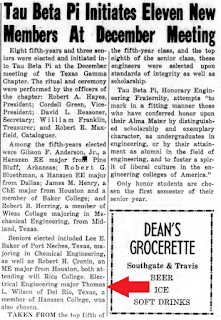
    Thresher article naming the engineers elected and initiated into Tau Beta Pi
    Mr. Wilson was at the top of his engineering classes.
  • His interests were not only in the sciences; he was also a member of Eulenspiegel, which had a description that, today, I find mildly alarming, and wholly uninformative as to its purpose.
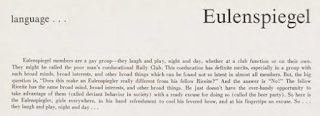
    An image of the description of Eulenspiegel that appeared in the 1963 Campanile.
    This likely would not appear in a description today
  • Tom took great exception to a professor's letter to the Thresher criticizing recent student activities,  mostly because it was submitted anonymously.
    Tom Wilson's letter to the Thresher in response to an anonymous professor's complaint
    Mr. Wilson did not approve of a professor anonymously authoring a critical letter to the Thresher

Mr. Wilson's patent is extremely technical, but for those who are interested, you can read it's entirety by visiting this link. 

Congrats to Hanszen for being the only Rice college to appear on a patent!

Credits for Thresher and Campanile images:  

The Rice Thresher (Houston, Tex.), Vol. 51, No. 13, Ed. 1 Wednesday, December 11, 1963. Rice University, https://hdl.handle.net/1911/66369.

Rice University. "The Campanile,1963." (1963) https://hdl.handle.net/1911/106133.

Rice University. "The Campanile,1964." (1964) https://hdl.handle.net/1911/106134.

The Rice Thresher (Houston, Tex.), Vol. 52, No. 11, Ed. 1 Thursday, December 3, 1964. Rice University, https://hdl.handle.net/1911/66396.

Friday, January 13, 2023

The Rice Space Elevator

During a recent extended family dinner, I mentioned to one of my family's Rice alums that Rice has many patents related to carbon nanostructures (such as those in the post about fullerenes), which led to a fun discussion. 

Apparently, during his day, it was popular for research proposals concerning carbon nanotubes--whether for grants, to advisors or departments--to sometimes mention their potential future use in building a space elevator.

Which led me to wonder if any Rice patents or patent applications included space elevators. 

To my disappointment, not a one outright admits to that aspiration.

However, there were dozens of carbon nanotube-related patents that do include "spacecraft" and "satellites" among their useful applications, and what is a space elevator if not a very specific type of satellite or spacecraft?

Most notable among them are:

  1. Application 10/033,228: "Method for producing self-assembled objects comprising single-wall carbon nanotubes and compositions thereof". It led to a total of 23 patents between 2004 and 2011, all of which mention applications in space as seen below.
    Page 23 of Application 10/033,228

  2. US Patent 7,407,640: "Functionalized carbon nanotube-polymer composites and interactions with radiation". Not only was the research for it funded in part by NASA, it mentions its use in various spacecraft and space research in more than one section.
  3. US Patent 7,262,266: "Copolymerization of polybenzazoles and other aromatic polymers with carbon nanotubes". This 2007 patent specifically states that the nanotube block coppolymers are ideal for space-faring vehicles; excerpt below.
    Page 5 of US 7,262,266

After quite a few highly entertaining searches, I found that it was much more likely for Rice doctorate candidates in a thesis dissertation, or faculty to co-author an article, that mentions space elevators. A quick search of our Digital Scholarship Archive returned three such dissertations and the one article. All four use space elevators much like what was explained to me: that carbon nanotubes are the most viable known material with space elevator material.

The faculty article references space elevators in the first introductory paragraph, explaining that due to the unique characteristics of carbon nanotube fibers, they "have received considerable interest for advanced applications ranging from military equipment, sensors, actuators, and energy storage devices to the space elevator" (emphasis added). (Lee, Dongju, Kim, Seo Gyun, Hong, Seungki, et al.. "Ultrahigh strength, modulus, and conductivity of graphitic fibers by macromolecular coalescence." Science Advances, 8, no. 16 (2022) AAAS: https://doi.org/10.1126/sciadv.abn0939.)

Each dissertation refers to space elevators in a similar context. Here are the citations so you can read those parts if desired:

  1. Page 6 of Zhou, Zhou. "Energy Storage Capacity and Superconductivity of Nanosized Titanium Diboride, and Multifunctionality of Carbon-based Nanostructures: Development of Nano-engineered Solutions." (2019) Diss., Rice University. 
  2. Page 5 of Cox, Paris. "Water Drop Tribology of Graphene and Polymer Nanocomposites." (2013) Diss., Rice University.
  3. Pages 9 and 48, among several other oblique mentions via aerospace, of Pint, Cary L.. "Synthesis, transfer printing, electrical and optical properties, and applications of materials composed of self-assembled, aligned single-walled carbon nanotubes." (2010) Diss., Rice University.

In the end, I hate to disappoint Rice's enthusiasts, but they aren't likely to win the space elevator race. Not only have some claimed to be working on viable designs already, but numerous patents for the space elevator concepts have been issued.

My favorite is from Lockheed Martin: US 6,491,258, "Space Elevator".


Wednesday, January 4, 2023

Basic Search Now Available

 Better late than never, some might point out: a new basic search mode for Patent Public Search, or PPUBS, was released mid-December. It wasn't given much publicity or announced before it was released, which led to a bit of confusion during a consultation here at the Kelley Center (the email announcement arrived a day or two later). 

At first glance, it appears fairly intuitive, if more similar to an advanced search one might see in a library catalog (like Fondren's) or a database/platform (like JSTOR). 

An image of the new PPUBS basic search mode
The new Patent Public Search Basic

Below the quick lookup for patent publication numbers, each search box has a drop-down menu with a fairly short list of common fields that don't require formatting like a suffix. Between the two search entry boxes is the drop-down menu of Boolean operators AND, OR, NOT. XOR and proximity operators have been excluded, which is understandable for a basic mode.

The brief set of query building instruction next to the search is about as long as possible for a basic mode, but it lacks explanation (or a link to one) of how Boolean operators work, which many people need.

Screenshot of the basic guidelines for query building in PPUBS
A few guidelines for building search queries
It is a strong start on a new design for a more basic, user-friendly search, but lacks a few key features that may alienate users:

  1. Only two search entry fields are available. Users cannot add more. This restricts searching, and will probably lead to lengthy, overwhelming results lists (high recall, low precision).
  2. There is no clear way to download, save, or print a list of search results. I am frequently asked if it is possible to download results lists in Excel-friendly formats. Many people want to use Excel to refine or organize results, rather than changing search queries. This tool's limitation to two search term boxes may make organizing or refining results in another program necessary. Furthermore, keeping track of searches and results is extremely important in any patent search, basic or advanced. 
    Screenshot of results list from PPUBS Basic Search
    Over 27,000 results is a lot to review without tools to organize or refine
  3. There are no refining options once results are returned. Usually, this is not problematic in a simple search mode, but here it is. Without some basic limitation options at the start--specifically to search within the databases of patent application or granted patents post-1970--it means novice searchers could be confused about what results are for patents versus patent applications. I particularly dislike the inability to change how the list is ordered. Post-search refinements like these are usually the same in both simple/basic and advanced search modes.

Screenshot of a results list from Fondren's OneSearch simple mode, and the refinement options
Fondren's OneSearch provides results refinement, left side, in both simple and advanced modes
These are three primary problems that immediately stand out.
 
My verdict: I would not recommend using the new basic search for discovery or research. It seems most useful for finding patents the user already knows, and then with document number, inventor, assignee, or other specific information from the searchable fields. It is a poorly constructed tool for comprehensive searching.

The USPTO released this version in response to requests. While I understand that Patent Public Search, released last February, may initially have been overwhelming, it isn't any worse than previous advanced patent search tools from the USPTO. Presently, the new basic mode's primary advantage is its appearance--one markedly similar to other search tools. 

Maybe Fondren User Experience could provide a few pointers? Let's hope some improvements are made down the line.


Monday, December 19, 2022

Plant Patents Saving the Planet

Every now and then, a plant patent catches our eye. Sometimes it's for mundane reasons--like the length requiring a special high-capacity stapler--and sometimes it's for a particularly unusual... not plant.

There is a whole class category for plant patents that are technically not plants: fungi. Mushrooms are grouped under U.S. Patent Class (USPC) 394. But what about algae, which is grouped into multiple kingdoms of life? That, apparently, belongs to USPC 395, which is "Miscellaneous". 

Earlier in 2022, Blue Ocean Barns was granted a patent for a new Asparagopsis taxiformis variety called 'Brominata'. That alone makes it stand out, as algae are not a commonly patented plant (or whatever kingdom of life).

PP34,607: Asparagopsis taxiformis 'Brominata'

Plant patent no PP34,607 is even more interesting, as it is meant to provide "a source of halogenated compounds to inhibit methanogenesis in animals (e.g. ruminant animals)." For those readers like myself, a bit of translation into common parlance might be needed. Basically, this algae was created as a feed additive for cattle to reduce their methane production (via flatulence), and therefore reduce their contribution to greenhouse gas emissions and climate change. 

'Brominata' parent plant image from the patent

Yes! Finally! An invention that will alter cow farts, making them less damaging to our ecosystem. 

Patents are saving the planet, one ruminant, one methanogenesis event, at a time.

A photomicrograph of undesired 'Brominata' spores from the patent.
A photomicrograph of undesired 'Brominata' spores from the patent

A photomicrograph of 'Brominata' gland cells from the patent